

PLANNING AND DESIGN
Energy Efficiency of Buildings:
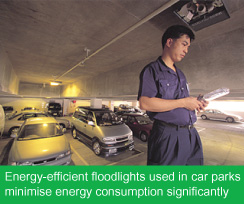
Energy-saving lamps have been widely used in housing estates for over 15 years, and about 60 new car parks have installed energy-efficient floodlights since 1995.
Automatic timer control systems have been adopted as standard lighting design practice for new projects. These systems have created significant energy savings of at least $2,500,000 for domestic blocks completed in 1999.
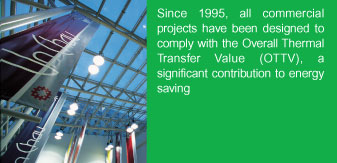
Since 1995, all new commercial building projects have been designed to comply with the Overall Thermal Transfer Value (OTTV) stipulated under the Building (Energy Efficiency) Regulation.

Lighting
installation for New Harmony Blocks, designed to comply with the
Lighting Energy Code requirements, was successfully registered under
the HK Engergy Efficiency Registration Scheme for Buildings in
November 1999.
Water Conservation and Quality:
We have included a smaller cistern of 7.5 litre in capacity in our specifications. The smaller cistern is as efficient as the traditional 9 litre ones. If the smaller cisterns are adopted in all new projects, consumption of flushing water can be reduced by more than 16%.
In 1994, the Authority introduced uPVC lined pipes for water supplies in all new projects. The new water pipes significantly improved the problem of water discoloration due to rusting of the galvanised iron pipes.
Air Quality:
Since 1996, nearly 400 new domestic blocks have been designed to have
generators installed on their rooftops instead of on ground floors, so
that emissions are dispersed away from residential areas.
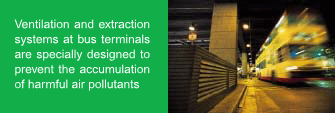
A design guideline for new projects was prepared in 1997 providing
detailed criteria for the design of ventilation and extraction systems to
prevent the accumulation of harmful air pollutants. About 30 car parks are
using the new design.
Since
1985, only non-ozone-depleting chemicals should be used in fire
extinguishing systems in all new projects. Similarly, we started using
non-ozone-depleting refrigerants in all chillers in 1992. Since 1996, we
have also completely phased out the use of CFC manufactured thermal
insulation for all air conditioning installations.
Minimising Noise Nuisance:
Since the early 1990s, noise control measures including provision of sufficient
buffer distances and adjustments to the layout of blocks as a result of
identified traffic noise problems have been adopted. Where these types of
measures are not possible, we locate noise-screening features such as car
parks and commercial buildings between noise sources and residential
blocks.
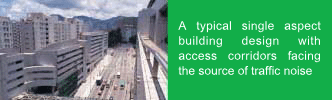
Since 1996, we have also adopted the single aspect building design, with
non-noise sensitive facades, such as kitchens, bathrooms and access
corridors, facing sources of traffic or other types of noise to minimise
noise impact.
Waste Management:
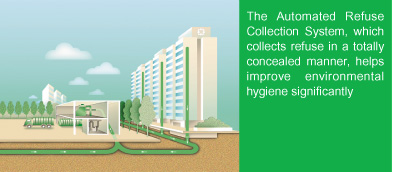
The Automated Refuse Collection System (ARCS) was approved by the
Authority in September 1998 as a standard feature for all domestic blocks
to be completed after January 1, 2001, wherever practical and economically
viable. The System allows refuse to be collected in a totally concealed
manner. Rubbish on each floor is transported by suction through ducting to
a central point, where it is compacted and removed by collection trucks.
Waste Reduction in Construction:
In 1999, our contract specifications were amended to require demolition and civil engineering contractors to separate inert (e.g. concrete, bricks and rubbles) and non-inert (e.g. timber) materials on-site. The objective is to divert inert materials away from landfill sites and to use them in reclamation at public filling areas and in site formation work.
Since January 1997, rubble from demolition contracts may be processed for re-use as hard-core and back-filling material. In addition, a trip-ticket system has been adopted to monitor transportation of construction and demolition materials to public filling areas/landfills for the prevention of illegal dumping by contractors.
Since 1990, all structural concrete for foundation works on Authority projects has incorporated PFA as partial cement replacement. To-date, the foundation works for over 200 Authority's construction contracts have used PFA added concrete.
Minimising Construction Nuisance:
Any violations of the Noise Control Ordinance, Air Pollution Control Ordinance and other relevant environmental regulations will be recorded and reported to the Authority for consideration of disciplinary action.
Water Recycling:
To conserve water usage, water-recycling systems have been installed in a number of construction sites to treat water with minor silt and soil contamination. Treated water can be reused on-site.

Conserving Resources:
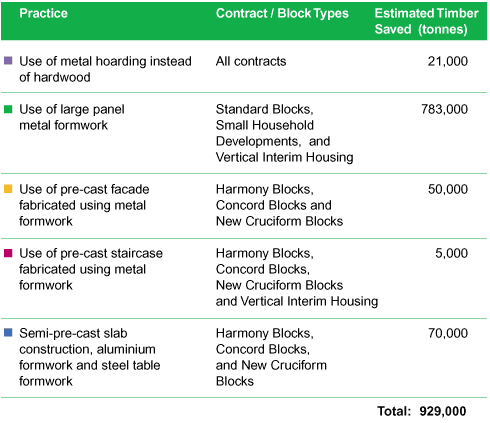
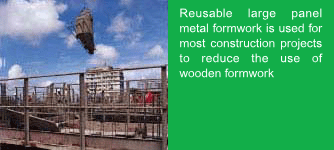
The estimated amount of timber saved by various measures adopted by the
Authority between 1985 and 1999 are summarised in the following table:
Waste Minimisation in Offices:
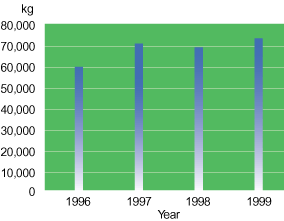
The initiatives include double-sided printing, minimising photocopies, reusing envelopes and using more e-mail. Staff members are also encouraged to put waste paper into green boxes for recycling.
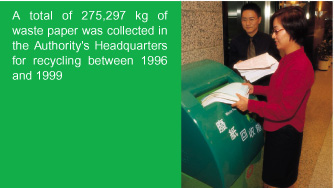
WASTE PAPER COLLECTED IN THE AUTHORITY'S
HEADQUARTERS BUILDING
Waste Management and Reduction in Housing Estates:
Started in 1991, the waste paper recovering programme was extended to all of the Authority's rental estates in September 1999.
The Waste Reduction Task Force established in June 1997, has set the target to reduce 40% municipal solid waste in ten years. For domestic waste in public housing estates, the target
is 20% in 10 years.
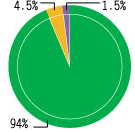
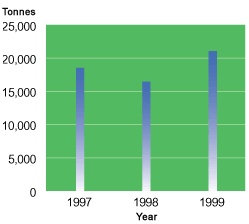
To-date, about 4,300 recyclable materials collection bins for separate collection of waste paper, aluminium cans and plastic bottles have been provided in rental estates managed by the Authority. A total of 22,539 tonnes of recyclable waste were collected in 1999.
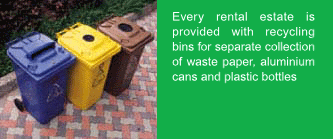
Cleansing contractors are required to collect and sort household waste for recycling daily; to send recyclable materials to waste recyclers twice a week; and to submit a quarterly report on the collection of recyclable materials to the Authority.
|
|
 |
|
|
|
|
|
 Waste
paper (21,106 tonnes)
Waste
paper (21,106 tonnes) Aluminium cans (1,015 tonnes)
 Plastic
bottles (418 tonnes)
Plastic
bottles (418 tonnes)
WASTE PAPER COLLECTED IN THE AUTHORITY'S HOUSING ESTATES
Various promotional campaigns to promote awareness among tenants and the public about the benefits of waste reduction were organised during 1999. These included the Green Living Campaign, the Recycling Credit Scheme and Waste Recycling Campaign.
Energy Conservation:
The Energy Management Co-ordination Committee regularly monitors electricity usage to avoid unnecessary consumption. Converting electricity accounts from general service tariffs to bulk tariffs to minimise electricity charges is also being closely monitored.
Over the years, a number of retrofitting programmes have been carried out to reduce the use of electricity. Replacing lamps with more energy-efficient lighting is an example.
Water Conservation and Quality:
In view of the leakage problem in many older estates, more than 120 km of underground water pipes were inspected between 1996 and 1998.
Further work on installing isolation valves and check meters to minimise water wastage is being implemented.
Air Quality:
All fire extinguishers using ozone-depleting chemicals have been replaced.
Among the 25 chillers using ozone-depleting refrigerants, 23 of them have been retrofitted with environmentally friendly chemicals. The two remaining chillers will be upgraded within the next two years.
In 1996, the Authority also completely phased out the use of CFC manufactured thermal insulation in air-conditioning installations.
At the end of 1999, more than 82% of the older developments containing asbestos had been abated.
So far, 64 asbestos surveys for schools in public housing estates have been conducted. Phase 2 of the survey programme will continue until October 2000 and will consist of a further 65 surveys. The remaining 131 schools will be surveyed before the end of 2001.
Two consultancy studies performed in collaboration with EPD measuring indoor radon levels in 48 public housing estates were carried out in 1994 and 1998 respectively. Both studies confirmed that low levels of radon were present in some estates, but concluded that the levels measured did not constitute a health hazard to residents.
Noise Management:
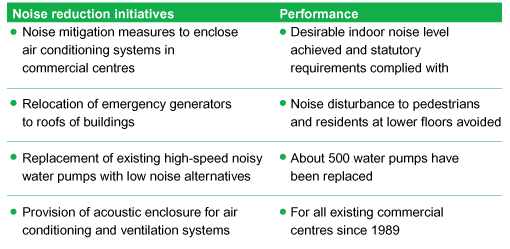
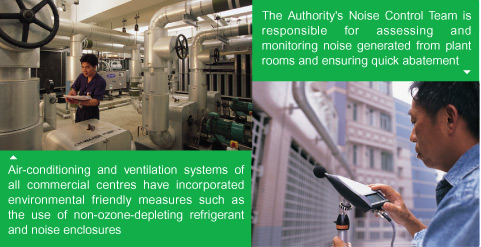
Since the establishment of the Noise Control Team in 1990, more than 200 noise mitigation cases have been resolved.
The following highlights some other noise reduction initiatives implemented by the Authority in the past few years:
WASTEWI$E SCHEME
The Authority joined the Wastewi$e Scheme organised by EPD in early 2000.
COMPLIANCE WITH ENVIRONMENTAL LAWS
A total of 96 cases of non-compliance with environmental legislation and regulations (such as violations of the noise permits in construction sites) have been reported to the Authority so far.
To enable us to continuously assess our environmental performance, an Environmental Information System will be established so that environmental compliance data will be reported to the Authority through the system on a regular basis by construction and estate management contractors. This information will include data such as the number of violations of construction noise permits and wastewater discharge licences, as well as violations of air emission standards and other regulatory requirements.
A more systematic and comprehensive database will also be established covering the amount of waste produced, recovered, recycled and reduced, as well as energy and water consumption data about our housing estates. An electronic system will be used to record the issues identified and to track the implementation of corrective and preventive actions.
 2001 Housing
Authority. All rights reserved.
2001 Housing
Authority. All rights reserved.