Hong Kong Housing Authority Close
 
  Environmental Performance
   
  Photo: We save energy through Administrative Measures, New Design and Technologies


Energy


Energy Conservation

Global warming, climate change and concerns over energy consumption continued to be high on the agenda of international agencies, national governments and corporate entities worldwide. Hong Kong is no exception. The Government continues in its efforts to promote energy conservation and efficiency throughout the public and private sectors.

To facilitate the achievement of this overall goal of the Government, the Housing Authority (HA) has implemented various saving measures to reduce energy consumption in offices, domestic and commercial premises. In July 2004, HA established the Special Energy Savings Working Group (ESWG) to review and monitor the progress and performance of the energy saving measures implemented. The ESWG is also responsible for the identification and initiation of new energy saving projects.


Energy Consumption

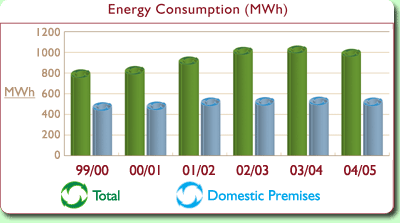
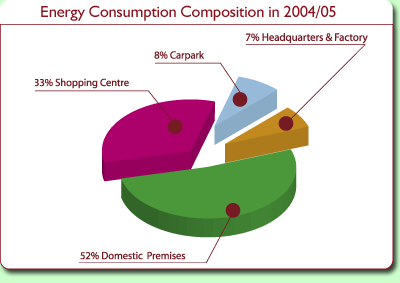
In 2004/05, our total energy consumption was 979 848 MWh, representing a reduction of 3.6% compared with last year. Domestic premises accounted for 52% of our annual energy consumption while our shopping centres and car parks accounted for around 33% and 8% respectively. Our offices together with factories and miscellaneous accounted for 7%.

HA has performed satisfactorily in the electricity reduction initiatives. At our Headquarters, we managed to reduce the energy consumption by 10.7% against 2002/03. This was noticeably higher than our target of 3% set by the Government. Comparing with the data in 2003/04, such reduction in energy consumption was 2.6%. We aim to sustain the level of electricity reduction per the Government target of 6% reduction by 2007/08.

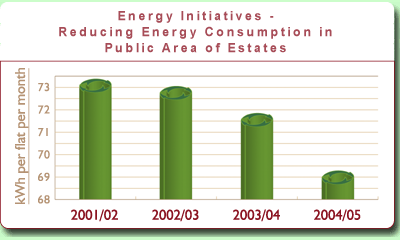
Electricity consumption in public areas of our housing estates also decreased by 3.59% over the same period, representing an average decrease in consumption of 2.57kWh per flat per month.

Simultaneously, throughout the reporting period we continued to identify initiatives that increase our energy efficiency and reduce overall energy consumption in all aspects from the operation of our own offices to the design, construction and management of housing estates and shopping centres.


Chart: Energy Initiatives - Reducing Energy Consumption in Public Area of Estates

  Chart: Energy Consumption (MWh)
Chart: Energy Consumption Composition in 2004/05


Energy Saving Equipment and Energy Efficiency Management

In addition to management initiatives, one area that we can make significant gains in conserving energy is through improving the efficiency of equipment such as air conditioning systems, lifts, lighting systems and pumps. To improve long-term energy efficiency, a new Design Guide was endorsed in August 2004, providing guidelines on design of energy saving equipment.

Examples of energy saving measures include:

At our Headquarters:

  • Reducing illumination in common areas wherever possible, including car parks after office hours.
  • Replacing existing controls for air handling units with variable speed drives and achieving a saving of approximately 2.5% energy after completion of the replacement in December 2004 .
  • Replacing all lightings at the two main blocks (Block 1 & 2) with electronic ballasts.
  • Adjusting temperature (25.5°C) and operating period of air-conditioning systems, as well as promoting staff awareness of the need for and methods of energy conservation.
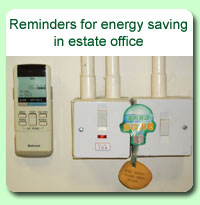
  • Appointing energy wardens to remind colleagues to comply with green housekeeping measures.
  • Increasing patrols by securities to switch off lights and air-conditioning.
  • Shortening the operating hours of air conditioners, lights and lifts.
 

Housing Estates:

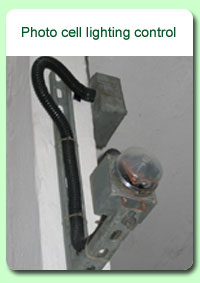
  • Using photocell lighting control in communal areas.
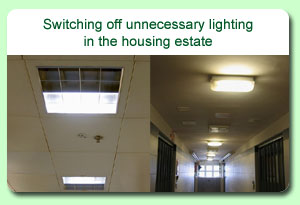
  • Switching off unnecessary lighting after midnight.
  • Setting illumination levels for lift lobby (85 lux), corridor (50 lux) and staircase (40 lux).
  • Adjusting timer settings to optimize the usage of seasonal daylight.

Commercial Properties:

  • Resetting the chilled water supply temperature as necessary throughout the year.
  • Minimizing outdoor air infiltration by means of air curtains and adopting free cooling during winter seasons.
  • Optimizing air conditioning supply during non-peak hours and in early morning and late evening.
  • Closing down lighting, lifts and escalators during non-business hours.
  • Improving the overall power factor efficiency.
Photo: Photo cell lighting control
  Photo: Reminders for energy saving in estate offtce Photo: Switching off unnecessary lighting in the housing estate
 

Enhanced Energy Efficiency Building

We continued to adopt the Building Energy Codes issued by the Electrical and Mechanical Services Department (EMSD) in all our new development projects. In the year, we had nine more of our public rental housing blocks certified under the EMSD’s Energy Efficiency Registration Scheme for Buildings.

Ongoing Studies and Trial Schemes for New Design on Energy Savings

In parallel with the above initiatives, pilot studies on new energy saving initiatives are currently in progress as set out in the following:

Installation of Nano-reflectors


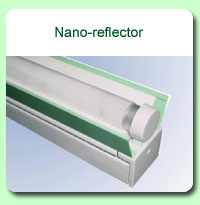
Trial installation of nano-reflectors was arranged at one estate management office in a Shatin project in late 2005. The nano-reflector reflects more light than conventional metallic reflectors by up to 99% of light beams emitted from the luminaire. 95% of the reflected lighting will be evenly diffused to the surrounding area. The combined use of nano-reflectors and fluorescent tube luminaires will enhance the quality of illumination while reducing energy costs.

Light Emitting Diode (LED) and self-luminous exit/directional signs

Two types of energy efficient exit/directional signs are currently under study, i.e. LED and self-luminous models. The LED model consumes much less energy and has a longer life span than the fluorescent tube for the conventional sign boxes. Self-luminous signs, which are permitted for use by the Fire Services Department, emit light through low level radioactive material. Sample installations of these two types of signs at another project in Shatin will be completed in April 2005 for operation. The effectiveness of the devices and feedback from tenants will be assessed for consideration of extending the trial schemes to other projects.

Lift Energy Conservation Research Study

Two preliminary studies on energy savings of lift services are underway. One study is to quantify the possible energy saving through adjusting the lift counterweight setting against the passenger traffic pattern. Another study is to evaluate the technical/financial viability of reusing of lift regenerative power through an add-on device developed by the lift manufacturer.

Environmentally Responsive Façade

A research study on environmentally responsive façade design in three domestic blocks using overhangs and tinted glass windows was conducted. It was anticipated that energy and hence cost savings in air-conditioning could be achieved. The project will commence its on-site installation work in mid 2006.


Photo: Nano-reflector
(c) 2006 All Rights Reserved   Top
English Traditional Chinese Simplified Chinese Text Version