


|
|
|
|
|
|---|
 |
 |
|---|
|
||
|
||
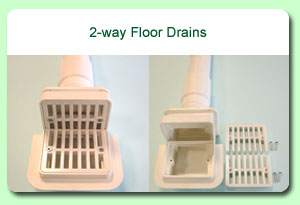
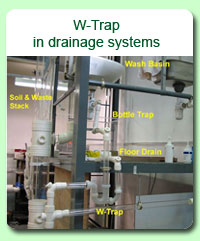
To improve the drainage network of our public rental housing (PRH) estates, we have implemented an ongoing comprehensive inspection and repair programme. In 2003/04, an academic institute was commissioned to audit the drainage design of our standard harmony blocks. Based on the audit findings, we updated our Specification Library to incorporate changes in specifications and testing requirements for all new contracts. We continued to undertake technical reviews of our re-entrant design to allow for easy inspection and maintenance from common corridors. Further to the incorporation of 2-way floor drains in 2002, we are now preparing for the trial of sunken shower areas in the coming year. In addition, the use of a common w-trap in drainage systems was tested in the past year, with results accepted in principle by the Buildings Department and the Independent Checking Unit of the Housing Department. This new design will be adopted for new PRH domestic flats subject to the flat layout and drainage configuration. In 2004/05, we undertook a study of new refuse handling systems aimed at improving the hygienic conditions of waste collection. Two new refuse handling systems, the Central Compactor System (CCS) and the Distributed Compactor System (DCS), have been endorsed by the Housing Authority (HA)’s Building Committee for implementation in newly constructed housing estates in the coming year. The CCS is proposed to be installed in housing estates of more than 2 400 flats as it will handle larger daily refuse outputs, while the DCS, with its smaller handling capacity, will be fitted into housing estates of less than 2 400 flats. A higher level of cleanliness and hygiene is achieved through a combination of control devices at the bottom of both systems, to prevent over packing of the refuse storage bins and spillage during collection and transportation. The feasibility of implementation in existing housing estates will also be examined. |
  |
|
Our recent Public Housing Recurrent Survey 2005 reports a trend of increasing satisfaction among our tenants on the cleanliness and environmental hygiene conditions in common areas of our PRH estates: 64% compared with 62% and 52% in 2004 and 2003 respectively. The number of cleanliness and hygiene complaints received also dropped significantly, from 2 123 in 2003/2004 to 1 577 in 2004/2005 (reduced by 25.7%). We look forward to further improving our performance. |
||
Preventive Measures |
|
Since the SARS outbreak in 2003, we have stepped up a comprehensive programme to improve personal and environmental hygiene in public housing estates. |
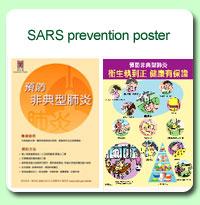 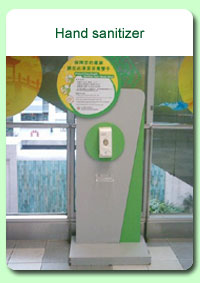 |
Besides raising the awareness of tenants and visitors in shopping centres, markets and car parks through posters and notices, we have continued to:
The “Drainage Ambassador Scheme”, which commenced in 2003, was completed in May 2004. With the assistance of over 100 ambassadors, we have performed inspections for some 430 000 flats and completed all drainage repairs identified. Another programme has been established to replace seriously corroded cast-iron drainage stacks inside flats at 18 estates by 2006. A three-level Response System: Alert Level, Levels 1 and 2 has also been adopted to ensure an efficient and responsive internal management system to deal with possible resurgence of SARS. The system sets out clear operational guidelines at each alarm level for frontline staff and property management companies, with actions to be taken in public housing estates as well as non-domestic properties depending on the scale and nature of risk. We continued to conduct practice drills to enhance the alertness and preparedness of our frontline staff. A tighter schedule was also set for cleansing contractors to clean up public areas such as lift control panels, playground equipment, recreational facilities and public toilets with 1:99 diluted bleaching agent. Canopies and refuse collection points were disinfected at least once daily. |
|
| Anti-Mosquito Measures | ||
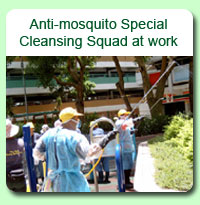
Over the past year, we have persisted with strenuous measures to eradicate mosquitoes and mosquito breeding grounds to prevent the spread of mosquito transmitted diseases such as dengue fever and Japanese encephalitis. In the rainy season, mosquito control works were stepped up on all fronts, including close monitoring of cleansing contractor performance at all our public rental housing (PRH) estates, commercial properties and construction sites. Special Teams at Estates and Construction Sites |
 |
|
At our construction sites, a total of nine mosquito breeding convictions were recorded in 2004/05, with the offending contractors duly fined. Our inspectors have continued to monitor the contractors to verify that improvement have been implemented. Educational Campaign Launched Furthermore, we co-operated with estate management companies and Estate Management Advisory Committees to carry out joint educational efforts. These included poster displays in lift lobbies and educational video shows in estate offices. Leaflets on the prevention of mosquito breeding were also distributed to our tenants. As a new initiative, action under the Marking Scheme for Tenancy Enforcement [Reference to Residents and the Community] will be taken against households where stagnant water is found to have mosquito breeding. |
||
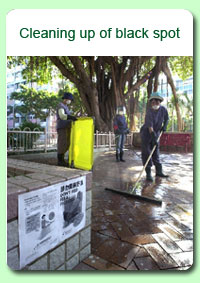
| Other Measures for a Hygienic Living Environment Under the hygienic living environment schemes launched in 2003, improvements have been achieved in the following areas: Marking Scheme for Tenancy Enforcement Stringent Enforcement Against Spitting and Littering Restaurant and Factory Tenants |
  |
|
The Scheme targets at offences associated with the abuse in the use of factory units, those with adverse effects on building control and environmental hygiene, or those posing a hazard to public safety. Penalty points will be allotted according to the seriousness of offence and will be held valid for two years. Tenants will be alerted once the accrued points reached 10 or more. Action for tenancy termination will be triggered when the mark reaches 16. Combating Illegal Cooked-Food Hawking |
||
 |
 Top Top |
|---|