Hong Kong Housing Authority Close
 
  Case Study
  Sustainable Community


Planning a Sustainable Community
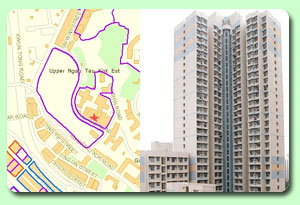
Redevelopment of Upper Ngau Tau Kok Estate Phase 2 & 3


Sustainable urban planning and design in Hong Kong, one of the highest urban densities in the world, is a challenging priority for the Government. Through Housing Department operations, we have the privilege of playing a key role in contributing to the sustainable development of Hong Kong. We fulfill this responsibility through our strategy for healthy living, sustainable construction and enhancement of the total urban environment. Concurrent with developing the future fabric of the city through new developments, we also take the opportunity to redevelop urban areas and revitalize old neighborhoods for the benefit of the local community. For this, the Housing Authority has initiated a Comprehensive Redevelopment Programme. In executing the programme we take considerable care to address sustainability, from planning and designing for sustainable operation of the housing facilities, to minimizing potential adverse environmental and social impacts by adopting sustainable construction methods.

Planning a Sustainable Community

Under the auspices of the Comprehensive Redevelopment Programme, the redevelopment of Upper Ngau Tau Kok Estate Phase 2 & 3 demonstrates how we put our strategy into action and plan for a sustainable community which balances social, environmental and economic requirements. The estate, which covers a gross area of about 3.5 hectares and will comprise six 40-storey residential towers and community facilities for a population of around 11 000, is expected to be finished by 2008. To achieve our sustainability goals, the overall objectives of the redevelopment are to:

  • Revitalize the old neighbourhood and improve quality of living through public housing redevelopment;
  • Enhance community involvement through consultation of District Council in the planning process and participation of local resident organizations in heritage conservation and community art design; and
  • Provide quality and affordable public housing for the target population.
 

Ngau Tau Kok Estate as it is Today

The estate was built in 1960’s and is bounded by Ngau Tau Kok Road in the west, Garden Estate in the south, a District Open Space (Kung Lok Road Playground) in the east and a Leisure and Cultural Services Department’s market complex in the north.
     
  Achieving Sustainability  


Considering the Environment

Environmental issues are a key focus during both the design and construction phases of the redevelopment works, and inevitably there are many issues to address. As an example, one of our main concerns is the functional energy efficiency of the development. We addressed this by using sophisticated microclimate computer modeling to create residential blocks and facilities configured in a Z-shaped layout which:

  • maximize natural light and hence reduce the extent and intensity of artificial lighting;
  • maximize the use of natural shade, which along with extra tree planting creates a cooler environment;
  • maximize natural ventilation and minimize solar heat gain, thereby reducing air conditioning requirements; and
  • improve wind flow in the surrounding streets, thereby improving the surrounding environment.


Photo: Comparsion of wind environment before and after redevelopment
 

Besides creating “environmentally oriented” housing, the above initiatives essentially create a pleasant and healthy living environment.

In terms of construction, through locating the blocks on bedrock, we are able to safely reduce the depth of foundations and hence minimise excavated waste for disposal. The use of precast concrete will also minimize the environmental impacts of construction, such as noise and air pollution, issues that unfortunately have adversely affected the quality of life for many Hong Kong residents in recent years.

Considering the Community

Throughout the entire planning and design process, we have liaised with the District Council and local concern groups to ensure that stakeholders concerns are addressed in the redevelopment planning process as far as possible. In particular, community involvement in heritage conservation aspects and in planning and designing the community art garden have proved to be invaluable in creating an environment that we hope local residents will both enjoy and be proud of, and that establishes a local identity. We have also taken care to create an environment that engenders social cohesion, through providing for a central gathering space, with a central plaza strategically located to serve as a venue for community-led social and cultural activities.

Since the elderly occupy a high proportion of the estate, we have also ensured barrier free access as well as providing a network of covered walkways and easily accessible pedestrian linkages to local facilities.

Last but not least, the Economics

It goes without saying that the redevelopment is being designed to optimize land use. To achieve this, at the same time as building to the maximum allowable plot ratio, we aim to maximize the use and amenity value of all open spaces and minimize land use for vehicular access and car parking. Through the planning process and consideration of all these issues, we endeavor to ensure an optimum balance of facilities for the benefit of residents. Since one of the goals of the Ngau Tau Kok Estate redevelopment programme is to revitalize the local economy, provision is also being made for supplementary retail facilities as well as providing easy access to existing facilities in the area.

(c) 2006 All Rights Reserved   Top
English Traditional Chinese Simplified Chinese Text Version