


|
|
|
|
|
|---|
 |
 |
|---|
|
|||
|
|||
The Environmental Protection Department (EPD) has identified the two main sources of waste disposed in Hong Kong landfills as domestic and construction and demolition (C&D) waste. At the current rate, EPD predicts our landfills will be full within six to ten years. [Source: Environmental Protection Department’s Website] To keep reducing domestic and C&D waste, the Housing Authority (HA) has taken proactive steps to implement various waste reduction and recycling initiatives not only in our offices, but also in our housing estates and construction sites. We will continue to deliver green messages to our tenants and our stakeholders to promote the 4R’s: Reduce, Replace, Reuse and Recycle. |
 [Source: EPD Website - Waste Statistics in 2004] |
||
Managing our Office Waste
We continued to take initiatives to demonstrate our commitment to waste reduction and recycling at our offices. In 2004/05, the total consumption of A3 and A4 paper in all our offices except site offices was approximately 143 000 reams, representing a reduction of 2.9% as compared with the data in 2003/04. Comparing with the data in 2002/03, we achieved a reduction of 5.3%, which successfully exceeded the 5% reduction target set by the Government in 2002/03. The paper saved amounts to 4 281 reams during the year 2004/05 alone. While paper consumption in our offices has been reduced, we managed to collect more waste paper for recycling in the past year. In 2004/05, we collected 159 187 kg of waste paper in all our offices except site offices, representing an increase of 7.6% as compared with the data in 2003/04. As our efforts to support the use of environmentally friendly materials, 100% of our publicity materials were printed with environmentally friendly paper in 2004/05. We continued to increase the percentage in consumption of recycled paper. Of the total paper used by the HA, approximately 54% was from recycled sources. |
|
||
 |
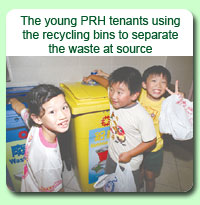
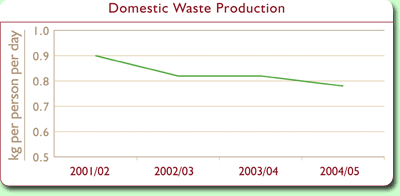
A number of waste reduction and recycling campaigns were launched in our estates with great support from residents. The HA’s Public Housing Recurrent Survey 2005 conducted in the first quarter revealed 73% of households recognized that HA supported environmental protection in public housing. In 2004/05, 151 of our estates participated in the Waste Recycling Campaign. Records of domestic waste generated in our estates indicated a 4.9% reduction from 0.82kg to 0.78kg per person per day in 2003/04 and 2004/05 respectively. This equates to 24% less than the daily average of 1.02kg waste generated by the Hong Kong population in 2004. [source : Environmental Protection Department’s website] |
|
 |
 |
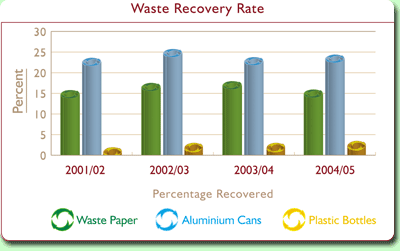
Overall, the domestic waste recovery rate of our estates in 2004/05 was broadly consistent with previous years. Our waste recovery rates for paper and aluminium cans were 14.4% and 23% respectively, with paper recovery slightly lower than the previous year (16% in 2003/04). This slight reduction may have been caused by the more favourable market prices for waste paper, resulting in an increased portion of indirect collection of paper waste by others. Plastic bottle recovery rate showed an increase from 1.4% in 2003/04 to 2% in 2004/05. In recent years, we have also worked together with charity organizations to promote used clothing recovery within all public rental housing (PRH) estates. However, in 2004/05, a 30.1% decrease was recorded in the overall volume of used clothing collected (533.5 tonnes), compared with volumes (763.3 tonnes) collected in 2003/04. The lower recovery may have been the result of reduced disposal of used clothing by our tenants, or better direct resale markets. In addition to those located at the ground floor lobby of every domestic block, we have continued to provide recycling bins at convenient locations in our estates to encourage tenants to develop environmentally friendly disposal habits. Up to March 2005, more than 27 000 households in eight housing estates have easy access to recycling bins in the common areas of their floors. |
|
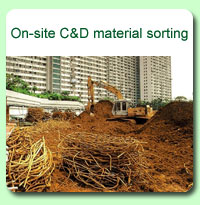
Effective Management of Construction and Demolition (C&D) Waste HA continues to seek new effective means to reduce the generation of C&D waste through all phases of design, construction, and demolition of building projects. In 2004/05, we derived a definition for the Construction Waste Index, which helps us effectively carry out quarterly surveys to determine the volumes of waste generated by each project. We have explored a number of opportunities to reduce C&D waste by implementing selective demolition at three school blocks in Lower Ngau Tau Kok Estate. Through this scheme, whereby fittings are removed first, followed by fixtures and building components and then finally demolishing the building structure, we are able to effectively minimize C&D waste and contamination from inert demolition materials and maximize material recycling and reuse. In 2004/05, our piling and demolition works generated a total of 140 000 tonnes of inert C&D material and 15 500 tonnes of non-inert C&D material, an approximate decrease of 77% and 73% from respective volumes generated in 2003/04. This significant decrease is primarily the result of new initiatives such as the use of more precast elements in construction and improved demolition techniques together with a reduction in redevelopment projects undertaken within the year. |
|
In our on-going efforts to achieve sustainable housing, further strategies on waste reduction have been implemented. These include:
|
 |
 |
 Top Top |
|---|